By Iurii Melnyk and Delfina Ertanowska
Information war before, during, after and instead of any physical war is a complex, multifaceted phenomenon that does not neglect any tools if experience shows their effectiveness. Laughter is one of the basic tools, because it has always been and is effective. Human psychology is so arranged that the ridiculous cannot be scary and vice versa – these feelings are almost impossible to combine. “If something is funny, it’s not dangerous any more,” Voltaire wrote.
Successfully exposing your enemy to universal ridicule means taking a significant step towards victory. In “The Great Dictator”, Charlie Chaplin seriously undermined the image of the sometimes fascinating, sometimes sinister and odious but always serious Hitler. It is psychologically much easier to fight against the ridiculous and clumsy Hitler than against an omnipotent leader who sweeps away everything in his path and makes the world tremble with fear. Dictators, whose image is usually formed in non-competitive conditions, are particularly vulnerable to satire.
Laughter deprives them of the aura of celestials, so they consistently curb any satirical encroachments on their sanctity: Putin does not want to be associated with Dobby, Erdoğan with Gollum, and Xi Jinping with Winnie the Pooh.
The power of cartoons
The genius of a cartoonist is in the ability to grasp the idea, to express the situation through a metaphor that hit the mark. It may seem counterintuitive, but the most offensive cartoons are those that reflect the true state of affairs (albeit exaggerated, revised, one-sided). On the other hand, a successful cartoon image in detail may not be entirely fair, but if it is built with talent, then the fictional elements may turn out to be truer than the truth itself. In the 1990s and early 2000s, the program “The Dolls” (Russian analogue of the French original) became extremely popular on Russian television.
The heroes of the program, dolls, were parodies of the most iconic politicians of Russia at the time. From the side of real politicians there were complaints that they allegedly did not have the habits and parasitic words that their dolls parodied with such regularity. So, at some point, at the peak of the program’s popularity, the dolls influenced the images of politicians, not the other way around, as participants in a talk show on NTV noted twenty years ago. By the way, after Putin came to power, “The Dolls” did not last long. According to one of the authors of the program, Viktor Shenderovich, the most sensitive episode for Putin was the one in which he was portrayed as Little Zaches. “I underestimated the visual power of the image, I underestimated the emotional power of the impact, and I underestimated, of course, the degree of this person’s complexes, because we were immediately told from several sources that there was an attack of rage,” Shenderovich recalled. In this episode of “The Dolls”, the authors unmistakably managed to capture the essence of the transformation of an inconspicuous KGB member into a charismatic authoritarian leader. The newly made dictator had to either accept him or do everything so that nothing of the kind could appear on Russian television.
The secret of a cartoonist’s skill is the ability to find accurate, true images. It is the eye sensitivity and not the ability of the graphic that is decisive, noted Jerzy Schwajcer (Jotes), the Polish cartoonist of the mid-20th century: “Sometimes a single flash of the drawn person’s eyes, an instinctive raising of the eyebrow, a fracture of the lips lasting for a fraction of a second, will tell the cartoonist more than hours of staring at the motionless face of a “priggishly” posing model”. If the cartoonist manages to unmistakably catch the object of his satire on a pencil, the new image will firmly adhere to him, and no rational counterarguments will be able to prevent this. It’s all about the nature of the cartoon, which lies or does not lie on our soul (tending to structure everything according to associations and plots). As Ukrainian researcher Orest Semotiuk points it out, “a political cartoon cannot be neutral or impartial. It clearly expresses the author’s attitude to reality and forces the viewer to approve or condemn this cartoon and the fragment of socio-political reality depicted on it.” Another question is how far these latter might be willing to go in their condemnation.
Prophet Muhammad cartoons
Tanzanian cartoonist Gado Mwampembwa once remarked: “The idea of being an editorial cartoonist is of course to speak the unspoken, to say things that many people would probably not say. And when you do that, of course you offend the people.” The problematic of Gado’s cartoons mainly comes down to exposing the shortcomings of African politics. Under undemocratic conditions, such an activity is playing with fire, because it requires the ability to balance on the verge between the goal to annoy the objects of a cartoon and the danger of a revenge.
The consequences for cartoonists who makes a mockery of somebody’s saint (both in quotation marks and without quotation marks) can be fatal. To see what an important tool of information war a cartoon could be, it is enough to take into account several precedents with attempts to depict the Prophet Muhammad in humorous drawings. When Danish newspaper Jyllands-Posten published a series of cartoons of the Prophet in September 2005, few could have imagined the scale of the further crisis: protests in the Islamic world against Denmark, the storming of Danish embassies and consulates; raising rates and expanding the scale of the crisis by the fact of republishing these cartoons in other European countries (as a sign of solidarity and fidelity to the principles of freedom of speech); as a result there was a multi-level diplomatic scandal, boycott of goods and sanctions, demonstrations and riots, dozens of casualties; cartoonists, including Kurt Westergaard, who portrayed the Prophet Muhammad with a bomb in turban, have been in danger for decades.
The Islamic Republic of Iran decided to respond to the attack on the Prophet Muhammad. In 2006 through the Hamshahri newspaper Iran announced a competition for the best cartoon of the Holocaust, thus trying to test the strength of the European principle of freedom of speech, which, they say, works so well in the case of ridicule of the Muslim prophet. Along with the predicted dissatisfaction and condemnation of this competition, it is worth noting the asymmetric reaction to it by Israeli cartoonists, who said that no one can match the Jews themselves in ridiculing Jews, and staged “The Israeli Anti-Semitic Cartoons Contest”, thus spoiling the overall effect from the Iranian venture.
The cartoons of the Prophet Muhammad were the subject of several scandals, the most tragic of which was the shooting of the editorial board of the French satirical magazine Charlie Hebdo in January 2015. It is noteworthy that as a result the magazine did not cease to exist, but, on the contrary, gained global popularity: the first issue after the terrorist attack appeared in almost eight million copies (against the usual 60 thousand). There was a Muslim prophet on the cover again, this time the author Renald Luzier (Luz), who was lucky enough to survive the terrorist attack, ironized, joked by placing a sign “Je suis Charlie” in Muhammad’s hands. This looked like another challenge to terrorists, although Luz himself later explained his motives in an interview: “Drawing Muhammad had nothing to do with revenge, the front page had to have a direct link with the reason for this drama and it is for this drawing that the colleagues died. I added a weird message to it: “All is forgiven” – who forgives whom? The drawing tells me, “We’re going to be okay because you’re still here to draw me.” But I will no longer draw the character of Muhammad, he no longer interests me”. Despite the position of this particular cartoonist, the magazine itself in January 2020, on the fifth anniversary of the shooting, again published cartoons of the Muslim prophet. In October of the same year, the daily La Nouvelle République published a cartoon of the prophet, in homage to Samuel Paty, the beheaded professor at Conflans-Sainte-Honorine, for which they received threats. All indications are that this story is far from over. One can look at this cartoon war in different ways – both to defend the values of freedom of speech and to condemn encroachments on other people’s shrines – but the indisputable lesson that can be learned from this scandal is the importance of cartoons (in particular) and laughter (in general) in information war.
Armenian-Azerbaijani conflict
The cartoons confrontation between the two countries is based on the classic examples known at least since the First and Second World Wars. “We” (own side is portrayed much less often and it is less interesting to discuss) do not evoke any negative emotions, only respect and solidarity in our struggle for the restoration of territorial integrity (Azerbaijan) or historical justice (Armenia). The main emphasis is made on “them”, on the enemy side, which is not just mean, insidious and cruel, but also funny in its meanness, insidiousness and cruelty. “Despite everything, you have to believe in life, in your victory and be able to laugh, including at the enemy,” Ukrainian cartoonist Andriy Petrenko said in the context of another, Russian-Ukrainian war.
The following components can be distinguished in the image of the enemy in the Armenian and Azerbaijani cartoons inspired by the Second Karabakh War:
1. Aggressiveness. In both Armenian and Azerbaijani cartoons, the enemy side is portrayed as an unambiguous aggressor: with rockets, axes, mines, and so on.


2. Responsibility. On the conscience of the enemies and their missiles there is the blood of innocent children, dead bodies and the like. As a rule, Pashinyan and Aliyev are personally responsible for human lives.


3. Fun. Both leaders appear in funny situations in cartoons, which calls into question their authority, highlights helplessness and failure.


4. Lowlying attempts to enlist allies. In the case of Azerbaijan, this is, first of all, Erdogan, in front of whom the Azerbaijani president crawls humiliatingly. In the case of Armenia, this is often Kim Kardashian, as well as Western leaders such as Macron.


4. Dehumanization. This is an important and ancient element of the information war: if you deprive the enemy of human image, it frees you from moral responsibility for his destruction. Armenians are seen by Azerbaijani cartoonists as crows, rats and cockroaches (the latter is a classic metaphor in the history of hate speech, which was used, in particular, by Free Radio and Television of the Thousand Hills during the genocide in Rwanda). Armenian cartoons depict Azerbaijanis in the image of jackals, and Presidents Aliyev and Erdogan in the images of a turkey, an inflatable doll, and a gin.


5. Defeat. According to the laws of information, the enemy should be instilled with a stable image of a loser. Armenian cartoonists glorify the powerful Armenian warrior, against whom, as in the cartoon by Vrej Kassouny (Վրէժ Քասունի), Azerbaijani, Turkish, Pakistani and generalized Arab opponents look pitiful and doomed to defeat. Azerbaijani cartoonists relish the corpses of Armenian soldiers who died for a useless cause.


The fifth component of the image of the enemy should include such an illustrative example from Azerbaijani cartoons, which gives a lot to understand the mechanisms of creating negative stereotypes about the enemy. Depicting funny, retreating Armenians, Azerbaijani cartoonists widely use the toilet, trying to establish an association between Armenia and this household item. The story that gave rise to this association is quite banal: a BBC video of an Armenian refugee taking everything from Karabakh with him, including a toilet. Azerbaijanis were able to competently (from the point of view of the canons of information war) approach this issue, make a big deal out of it and to create a stable negative meme about the Armenians.


Like any other information phenomenon, cartoon is both a constructive form that is great for raising important issues, drawing attention to pressing issues, and a weapon in information war. A media-literate society must be aware of the dangers of cartoon in its second function.
Iurii Melnyk: PhD in social communication, associate professor of the Department of Foreign Press and Information, The Ivan Franko National University of Lviv, Ukraine, melnykiurii@gmail.com
Delfina Ertanowska: MA in Journalism Media and Communication, University of Information Technology and Management in Rzeszow, Poland, independent journalist, del_fina@onet.eu
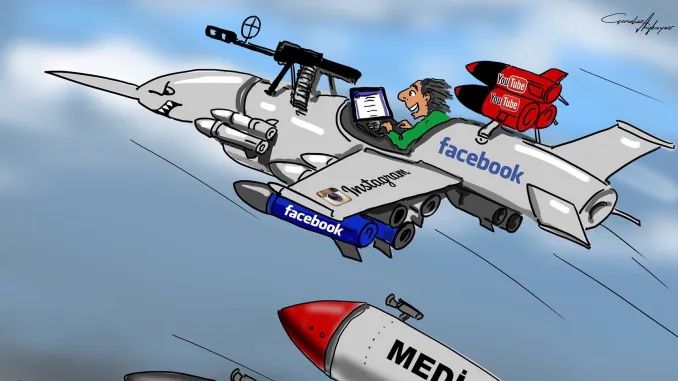
The title picture is a cartoon by the Azerbaijani cartoonist Gunduz Agayev.