by Alina Arustamian
Five informative and eventful days are behind us, as the Berlin stage of the international project Media Dialogue for Pluralism and Understanding ended. The Covid-19 pandemic and the war in Armenia have changed the format of conferences and our meetings, but new technologies have “erased all borders between the participating countries”. We creatively adopted to the new conditions by communicating via video calls. So, despite these inconveniences, we did great work and now we have something to share with you!
During the five days we had a lot of interesting presentations from the main speakers on various topics about the media situation in the different participating countries. Simultaneously the project’s participants worked in three groups (audio, video and blog). The main focus throughout the week lied on the media system in Germany and the role and the state of media during the hostilities in Nagorno-Karabakh. Besides these two focus topics we discussed the current media situation in the participating countries, the role of the media in conflict/war situation (Hrant Melik-Shahnazaryan), monitoring Facebook during elections (Giorgi Jologua), propaganda, fake news, hate speech in traditional or social media (Kateryna Sokolova), journalists under pressure (Lina Kushch), media regulation in Germany (Christian Semar and Alexander Natt), protection of minors (Marc Jan Eumann), and even photojournalism (Monika Plhal) so on.
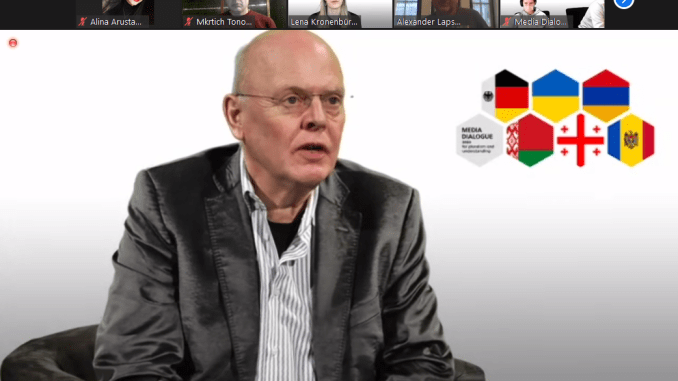
The results of the project were summarized in the final online conference that took place on October 23rd. On this day, each participant or speaker of the project had the opportunity to summarize the work during this stage of the project and thank the organizers, foreign or local colleagues for sharing their knowledge and active participation.
Wolfgang Ressmann, managing director of OK-TV Ludwigshafen, presented the ideas and goals of the project and mentioned the three main problems that influence the work of media in participating countries. He said that the first challenge is the Covid-19 pandemic, the second is the situation in Belarus and the third one the war in Nagorno-Karabakh. He also thanked all participants, keynote speakers and media trainers for their work. Mr. Ressmann mentioned that in the beginning, he was a bit little sceptic about such a new format, but our flexibility and the combination of starting with two online seminars and then doing the working week, worked really well and allowed us to reach great achievements. He also summed up and highlighted the main aim of the project: “I think that we all have one big idea that journalism is one of the most important things in the building of democracy, informing people and build up a peaceful world. And how necessary, a peaceful world and a peaceful continent are when we will have a look at Armenia, Belarus and the Donbass situation too. And one of our things is that journalism doesn’t feed the flame – tells the truth!“.
The ending conference continued with the speech of Mkrtich Tonoyan, the head of AKOS Cultural NGO based in Armenia. He briefly thanked all participants as well as organizers for an informative week and work. Mr. Tonoyan underlined the importance of discussing issues and communicating between participating countries: “We accepted challenges, overcame the restrictions and talking to each other. A human being is a social creature. That’s what I believe in, so we need to talk to each other.”
Volodymyr Danyluk, the head of the Forum of Ukrainian Journalists, stated that in the frame of the project young students and their media trainers showed their strong sense of responsibility, wonderful cooperation and work in groups. He also thanked the Federal Foreign Office of Germany (Auswärtiges Amt) for funding the project and contributing.
Kateryna Sokolova from Institute of Journalism in Kyiv expressed her gratitude to the Armenian side for the organization of the important keynote speakers’ speeches about the current situation in Nagorno-Karabakh. She also mentioned the great work of the groups and thanked the media trainers (Gustav Spahn, Sebastian Wessel and Minoas Andriotis) for their supervision and help to participants. Mrs. Sokolova hopes that we will continue the project in the same friendly atmosphere: “I hope that we will continue in the same psychological climate during the Armenian stage. And I really hope that the Armenian stage will happen!”.
In addition to the speeches the members of each group presented their work and achievements they achieved during the week. You can read more about them by clicking here.
And of course, it is impossible not to mention the work of those people without whom online conferences and the organization of our work could not take place at such a high level. Thanks to the technical support and to the translator Alina Stefanovic for your work. And special thanks to Media Dialogue conference moderator Lena Kronenbürger. You have done a great and important part of the work and have always tried to make our online conferences livelier and more positive. We appreciate your contribution!
Finally, we had an exciting week, performed and showed great results despite the new conditions and pandemic restrictions. We are not going to end there. There are equally exciting working weeks upcoming. We hope everything will go according to plan and nothing will stop them from happening.
So, have a look at our website with all the articles written during this week and check out our Facebook, Instagram and LinkedIn. Follow our news and wait for new works. We promise a lot of interesting things!