by Ani Meladze
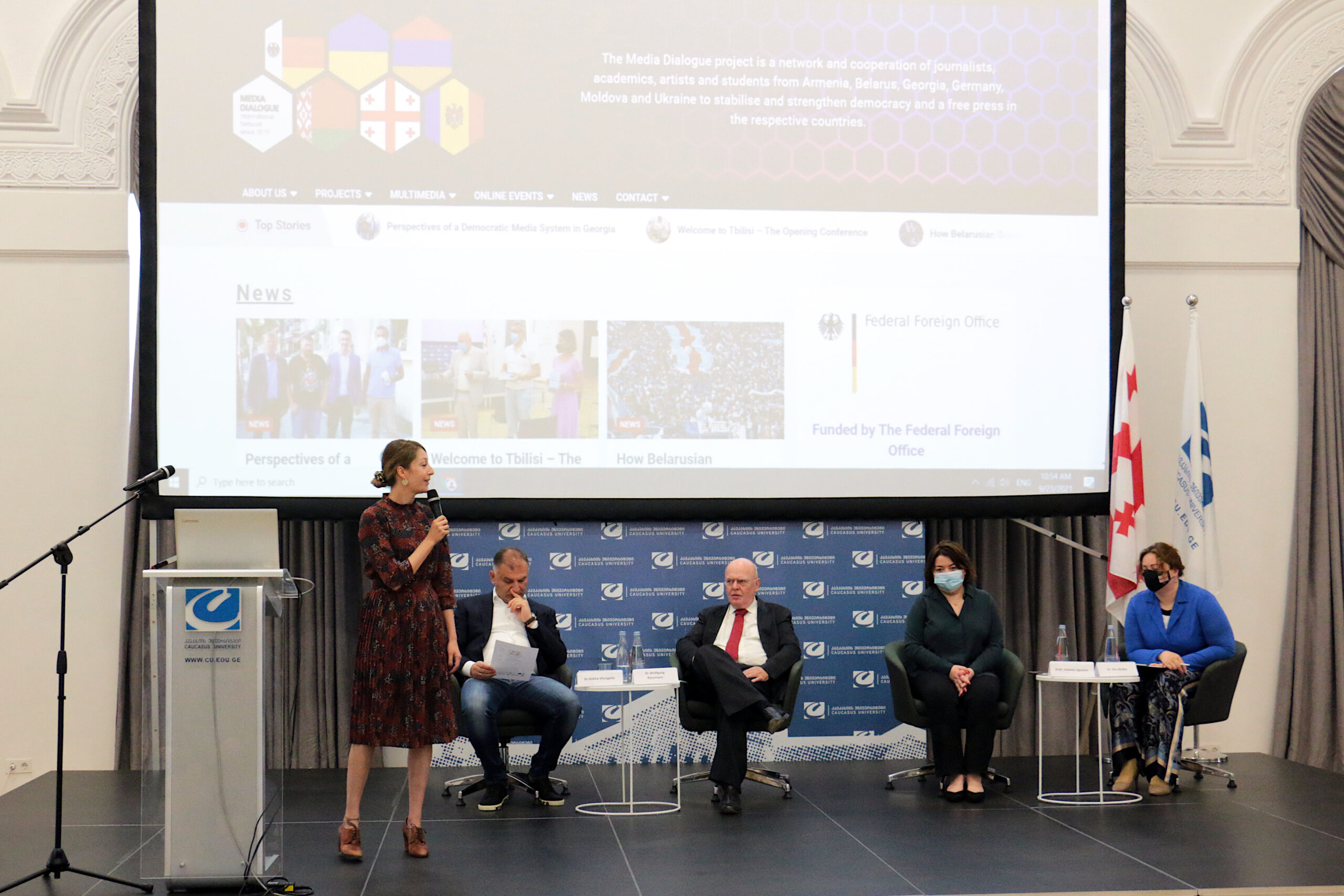
The first stage of the project Media Dialogue 2021 was dedicated to questions related to the topics of conflict sensitivity and research. After the first three productive working days in Tbilisi a conference was held to sum up the results so far but also to listen to different presentations by journalists and scholars and open up a space for discussion about the presented topics.
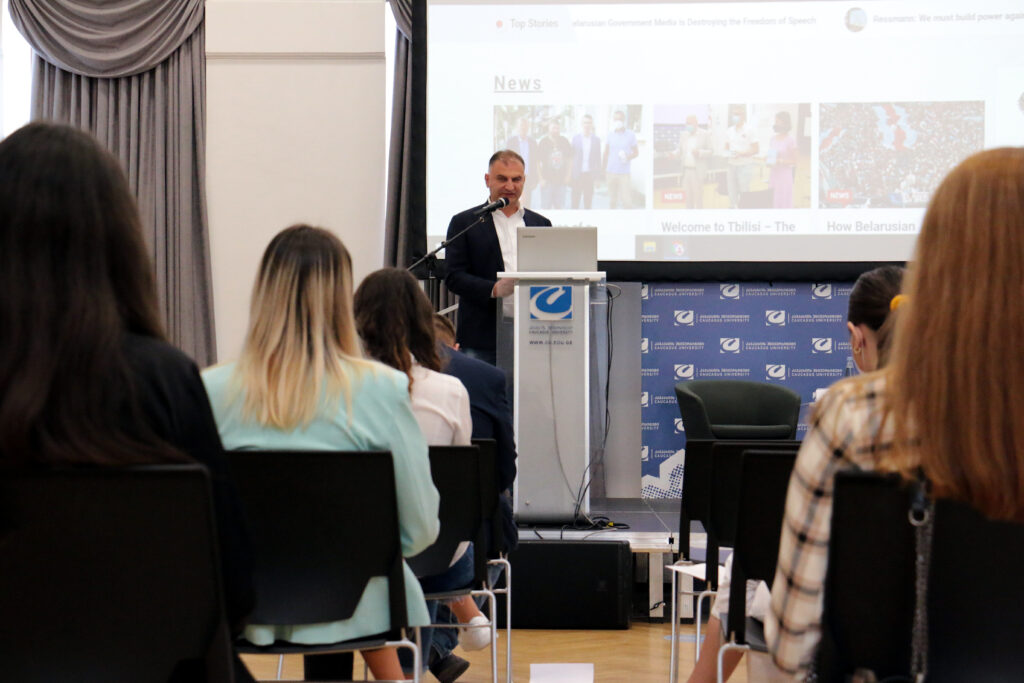
The conference was opened by Caucasus University’s president Kakha Shengelia and the project’s coordinator Wolfgang Ressmann.
Mr. Shengelia warmly welcomed the international guests and thanked the project organizers for their contribution to this collaboration between people and organizations from eastern European partnership countries and Germany. In his opinion the project’s organizers and participants are doing an amazing job in developing the Media Dialogue network.
Wolfgang Ressmann, chairman of the Association of Citizen Media in Germany, talked about the importance of the Media Dialogue and once again reminded the audience of the main purposes of the project. He highlighted how media freedom is threatened not only by economic and political dependencies, but also by attempts to manipulate public opinion through fake news, propaganda and hate speech, especially with regard to social media platforms.
Volodymyr Danyluk, chairman of the Forum of Ukrainian Journalists, discussed the media situation in Ukraine and how the his organization is trying to overcome the difficulties they are facing every day. He also mentioned that he thinks that much more pluralistic environment for media representatives have to be created.
Mkrtich Tonoyan, president of the AKOS Cultural NGO, noted the traumatic political and economical situation in Caucasus region and gave the participants a perception of how to fight against the hardships we are facing today.
Eka Akobia, the dean of Caucasus School of Governance, talked about the political situations and current events that are taking place in Georgia. As she said, the biggest problem are the informal groups, who must play a role in check and balances but are fully managed by group of rulers. The undermined environmental democracy in Georgia is the result of crisis situations, since it is directly reflected to the economic. Mrs. Akobia said, that without active media, the citizens would not even know the majority of the cases and irregularities that go against democracy.
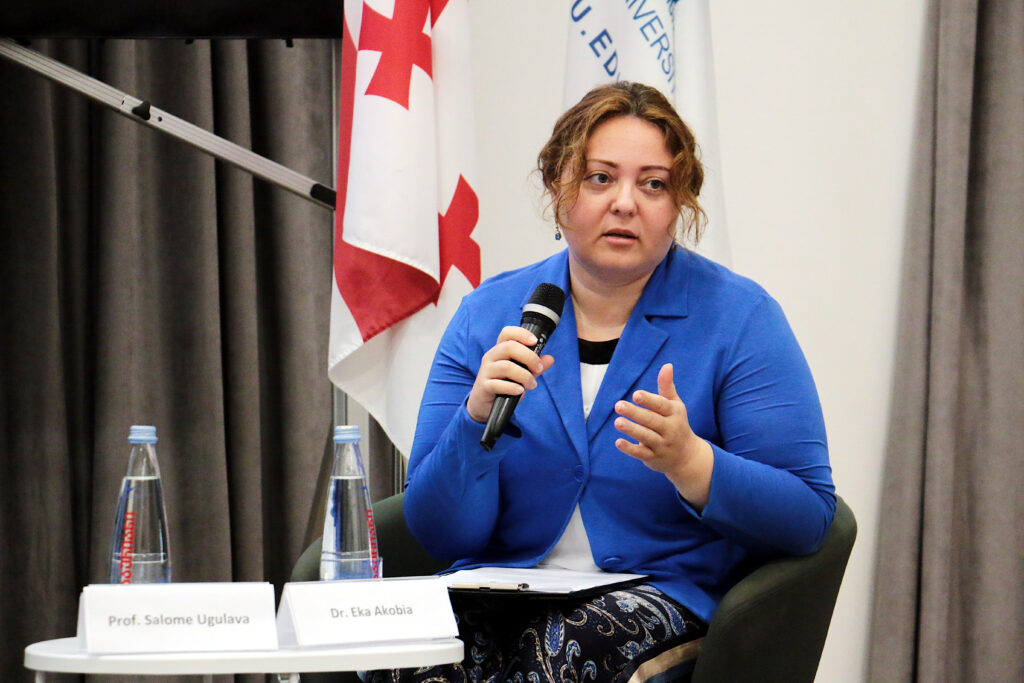
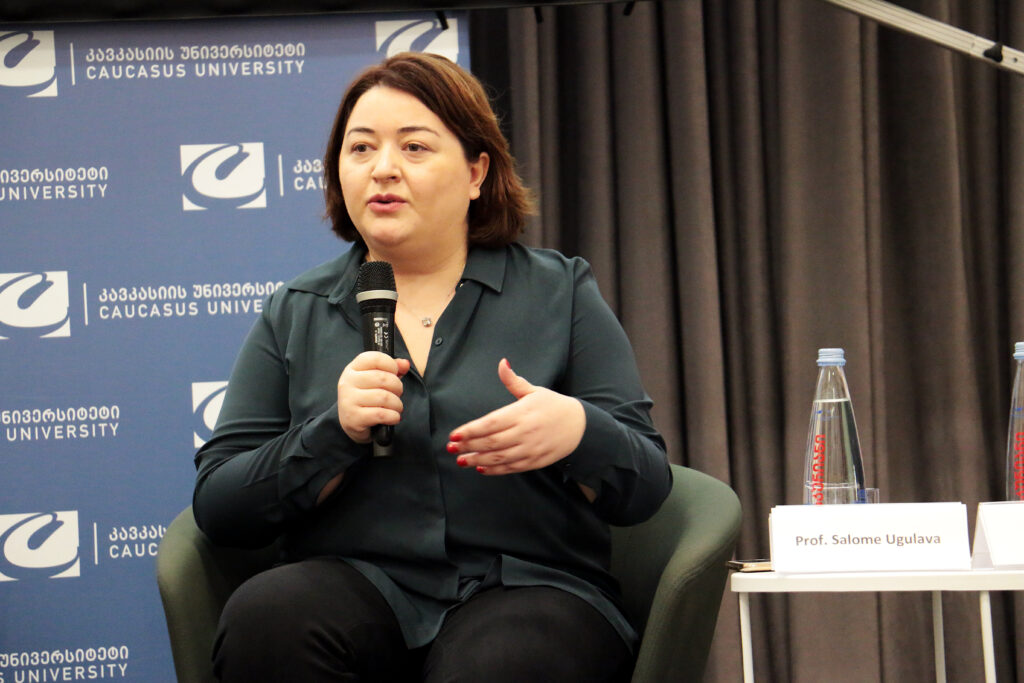
“Journalism in Georgia is under the biggest pressure I have ever seen”, said Salome Ugulava, lecturer at Caucasus School of Media. As she uttered, Russian propaganda is quite present in Georgia and tries to to affect the public opinion and to convince the citizens that it is the only choice for soviet countries. However, disinformation campaigns do not only come from Russia, because the government is cooperating as well. Even though media are the strongest and independent voice in Georgia, journalists do not feel protected and are not in a good situation because they get attacked even in the streets for doing their work.
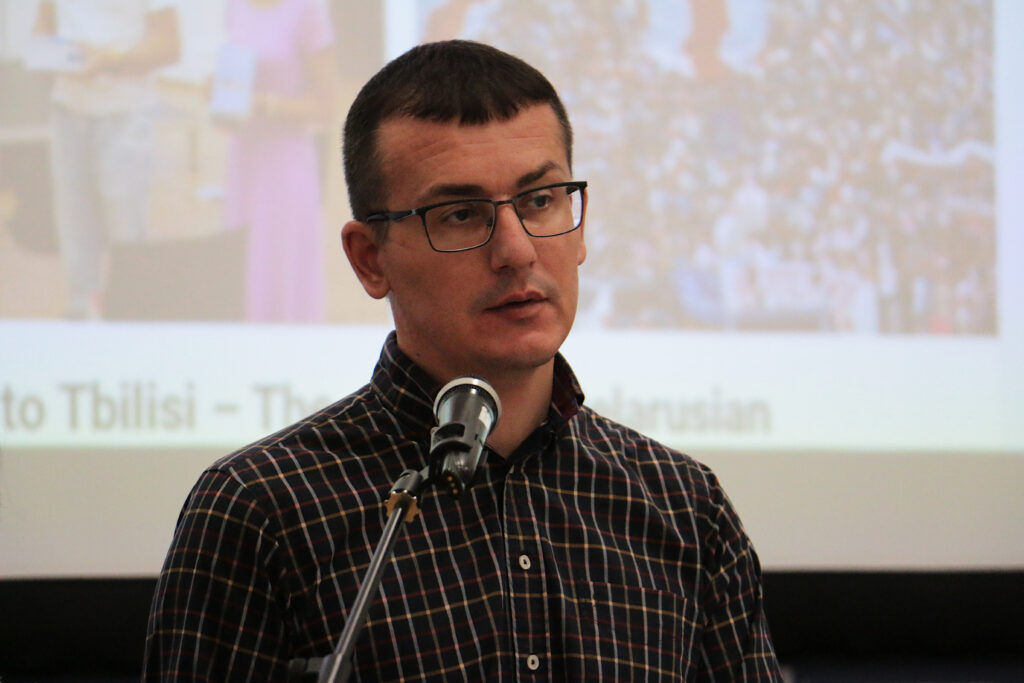
Andrei Mialeshko, member of the Belarusian Union of Journalists, shared his experience about the repressive situation in Belarus and how he and thousands of citizens had to leave the country for safety reasons. The restrictions were not only against activists but for journalists as well. In 2020 more than 500 media representatives were arrested by the police and nowadays there are more than fifteen cases of physical violence against them. Mr. Mialeshko hopes that this situation in Belarus will hopefully end soon.
Serhiy Tomilenko, chairman of the National Union of Journalists of Ukraine, talked about violence against journalists. As he said in his final speech, pressure against journalists is growing because they must deal with offline and online harassment.
“In Ukraine we have a great number of aggressions towards journalists. Each year more than 70 cases of physical attacks on journalist are recorded by the National Union of Journalists of Ukraine. And more cases like these are not investigated effectively. It is not only a physical attack, it is also an attack on people who know the truth.”
Serhiy Tomilenko thinks, that the best way to do end this situation in Ukraine is to have a successful investigation of this cases, with the help of the government and police.
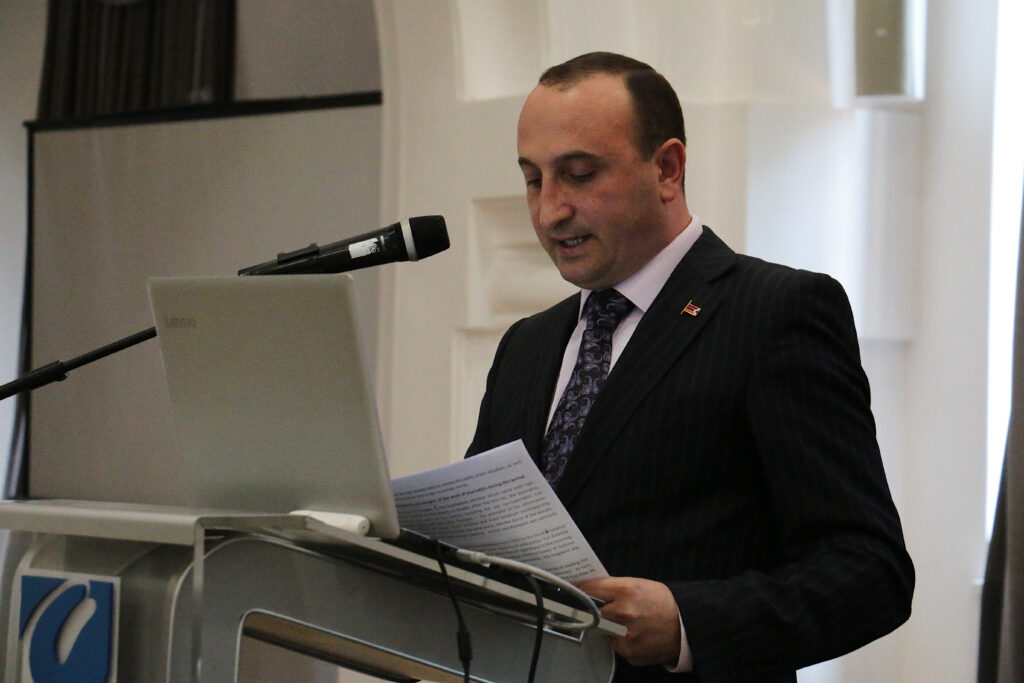
Vladimir Harutyunyan talked about conflicts and media while covering wars. He mentioned that information coverage of armed conflict currently plays a significant role, since it affects the world public opinion regarding the actions of one or another part to the conflict. In his opinion, the main requirements for mass media is efficiency, reliability, comprehensiveness, impartiality.
At the end of the conference, the blog group and the video group presented their results in the field of media, politics and conflict, which they were working during the Media Dialogue 2021 with their project partners and coordinators.
After the conference the Media Dialogue team went to Armenia’s second biggest city, Gyumri, where the second part of the first project stage of the Media Dialogue 2021 would continued.