
By Alina Arustamian
The Ukrainian week of the international project was full of exciting speeches of keynote speakers and important topics. Among them was the interesting presentation of Alona Romaniuk, editor of the non-governmental project “On the Other Side of News”. She described the team’s work on resisting fake news and propaganda in social networks and media. And she also revealed details and insights of an experiment with fake news about ball lightning, which she conducted to study compliance with editorial standards in the Ukrainian media.
About the project
The project’s editorial staff refutes the fakes and tells how the manipulations work. “On the Other Side of News” is already operating for 2.5 years and is successfully fulfilling its mission.
It is important to note that the information campaign of the project aims to increase media literacy and is a part of the international project “re: start democratic discourse” in partnership with the European Centre for Press and Media Freedom (ECPMF), Leipzig, with the support of the German Ministry of Foreign Affairs.

The experiment with fake news about ball lightning
The experiment with a fake news for the media was conducted in August 2018. A press release was sent to the editorial e-mail addresses of Donetsk, Luhansk, Zaporizhia, Kherson and Mykolaiv Oblasts, which included forecasts of experts from the fictional World Ocean and Atmospheric Administration on the appearance of ball lightning in these regions.
Despite the foolishness of these news, the information about it was spread by more than 70 media outlets in 5 hours. In 7 hours, it transformed from the regional level to the national level. The next day the plot was released in the final issue of TSN on 1+1. In total, this information was disseminated by more than 200 media outlets throughout Ukraine. The news were widely discussed on social networks. Videos about it were watched by more than 450,000 users on the Internet.
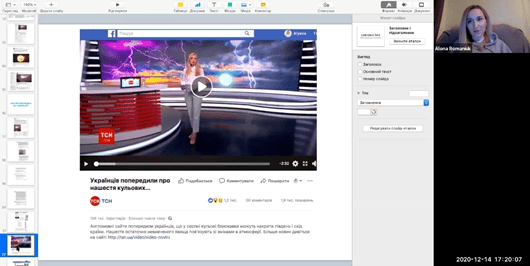
The fact that it was a fake was immediately understood by the journalists of Bakhmut Vecherniy, so they published this information on their resource. A comment of the Ukrainian Hydrometeorological Center was taken by journalists of Tavriya News and UNN News Agency. However, the rebuttals were spread only by about 10 media outlets and several groups on social networks.
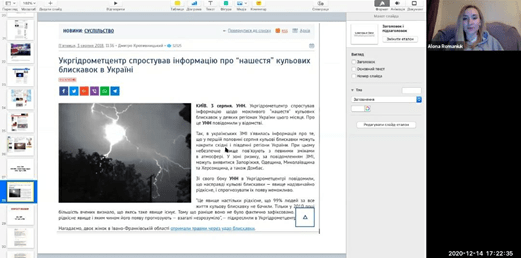
Two weeks after the wave of fake spread ended, the organizers of the experiment made it public and explained it.
The press release, written using several manipulative techniques, was easily taken for granted by journalists and editors of about two hundred media outlets without any attempt to verify the information. Units of journalists tried to find out details. So, what’s the secret for creating a press release that media believe in?
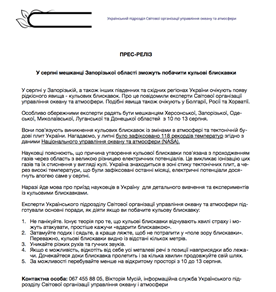
Alona Romaniuk chose several of the most common manipulation methods of running fakes that she wanted to present the project’s participants:
• The half-truth method
This method aims to create the most plausible informative story and write about a topic that is really relevant and interesting to readers. Thus, the experimenters used Google Trends, which helped them determine that more than 5,000 users in the last week of July 2018 were looking for information about ball lightning.
• Substitution of concepts
This means renaming one concept to another fictional or completely different. For instance, The National Oceanic and Atmospheric Administration (NASA), mentioned in a press release, has the same abbreviation with The National Aeronautics and Space Administration, which has nothing in common with ball lightning and forecasts for Ukraine.
• Reinforced by authoritative opinion
The authoritative name of organizations or people always influences the rational perception of fakes and information. That is why, in her experiment, Mrs. Romaniuk created the “Ukrainian Division of the World Ocean and Atmospheric Administration”.
• Game for relevance
Current issues, topics and pursuits of journalists for the efficiency and loudness of the news, often makes them neglect to check the sources of information and comments of experts.
• Playing with emotions
As soon as there is a play with emotions, the rational thinking of the audience and people gets affected. They become more vulnerable to fake news and more easily perceive it as the truth.
The purpose and conclusions of the experiment
According to the speaker, Alona Romaniuk: “For me, it was an experiment and its purpose was to show regional journalists from five regions, which are more subjected to Russian aggression, because they are still borderlands, that it is necessary to verify information and that it is easy to launch fake through them”. So, the main aim was to check how Ukrainian journalists adhere to professional standards and show them by example the process of spreading fake news.
Summing up, the editor of the non-governmental project “On the Other Side of News” noted why people so easily perceive false information as truth: “On the one hand, people like to believe fakes, on the other hand, fakes are always simple. They always give simple answers to complex questions… Therefore, a lot of simple answers are given by fakes. They are simple, they impress the emotions, so people believe in them.”
That is why, always check the information, be attentive, responsible and “Don’t feed the flame – tell the truth!”