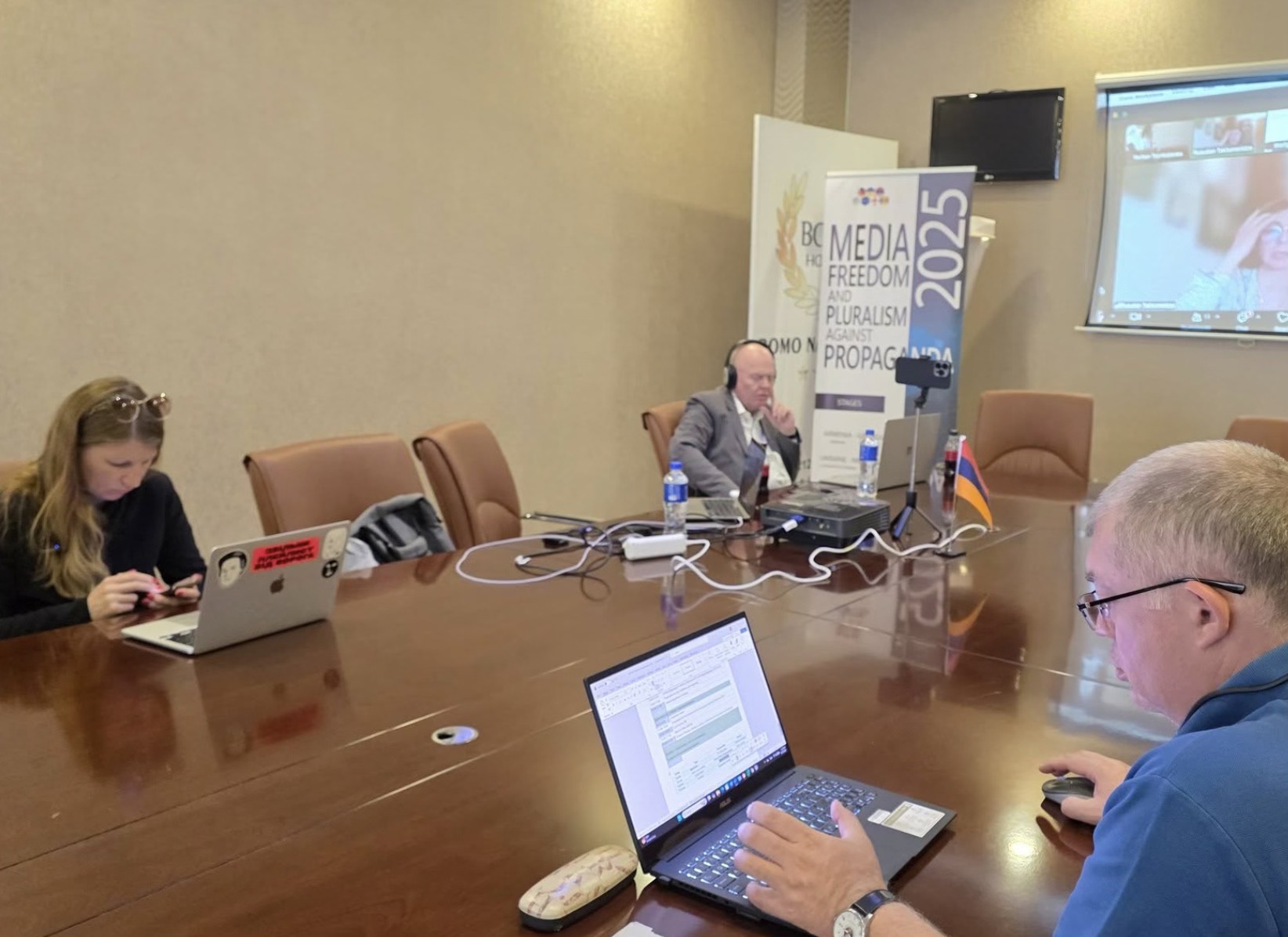
This year’s Media Dialogue could not go as planned, since part of this year’s project was initially scheduled in Georgia. However, following the adoption of new laws by the ruling party, “Georgian Dream”, resembling the Russian-style “foreign agents” legislation, the situation became unsafe. It posed a direct risk for Georgian participants, while for Ukrainian and Belarusian participants, travelling to the country could have led to serious consequences. For security reasons, the organisers moved the program entirely to Yerevan. Nevertheless, Georgian journalists who refused to remain silent were still actively involved in the Media Dialogue 2025.
One of those was Ekaterine Basila, the founder and executive director of the Centre for Media, Information, and Social Studies (CMIS) in Georgia. On September 25, the Media Dialogue 2025 participants had a Zoom meeting with a journalist and had a chance to learn more about journalism in her country.
According to Ekaterine Basilaia, independent media are suffering from suppression at different levels, including legal suppression (e.x, Foreign Agents Registration Act (FARA)), various physical attacks, and the adoption of legislative changes.
“The civil society has been in crisis for the past 3 years. The crisis that was unimaginable a few years ago. As an organisation, working on the journalists’ rights and documenting crimes against journalists for the past several years, I can say that the Georgian media has been cornered, without an existential threat right now”, Ekaterine Basilaia said.
She emphasised that independent media cannot receive grants without the government’s approval; therefore, this approval is also impossible to obtain.
“Some journalists have been affected by the lack of funding, or the impossibility of receiving salaries, etc. There are at least 30 organisations that are under inquiry. Two financial accounts of seven organisations have been frozen due to their connection with the protest movement – they allegedly purchased some protective equipment for the protest representatives and the media, ” said Ekaterina Basilaia.
At the same time, disinformation campaigns and conspiracy theories have been in the country for a few years, also trying to portray independent media and civil society as enemies of the country, against the nation’s interests and Georgia’s sovereignty. In a way, it has impacted how some parts of the population view it.
“I can’t speak for 100% of the Georgian population. Of course, some people probably support the “Georgian Dream”, but I don’t think that’s a big number, because those pro-EU people recognise that the ‘Georgian Dream’ today is a big problem for Georgia, ” answered the founder of CMIS.
The journalist stated that this conclusion is based on public opinion polls and large demonstrations in Georgia. Mentioning the coverage of protests by public broadcaster Ekaterine Basilaia, noted that they reported objections from Georgians as one of the developments in the country.
“State media is a problematic actor, and has been, I think, here during the times of every government. Covering the protests means that you have to cover what the protesters want to share with the public. But they have not allowed critical voices to be heard”, – Ekaterine Basilaia explained.