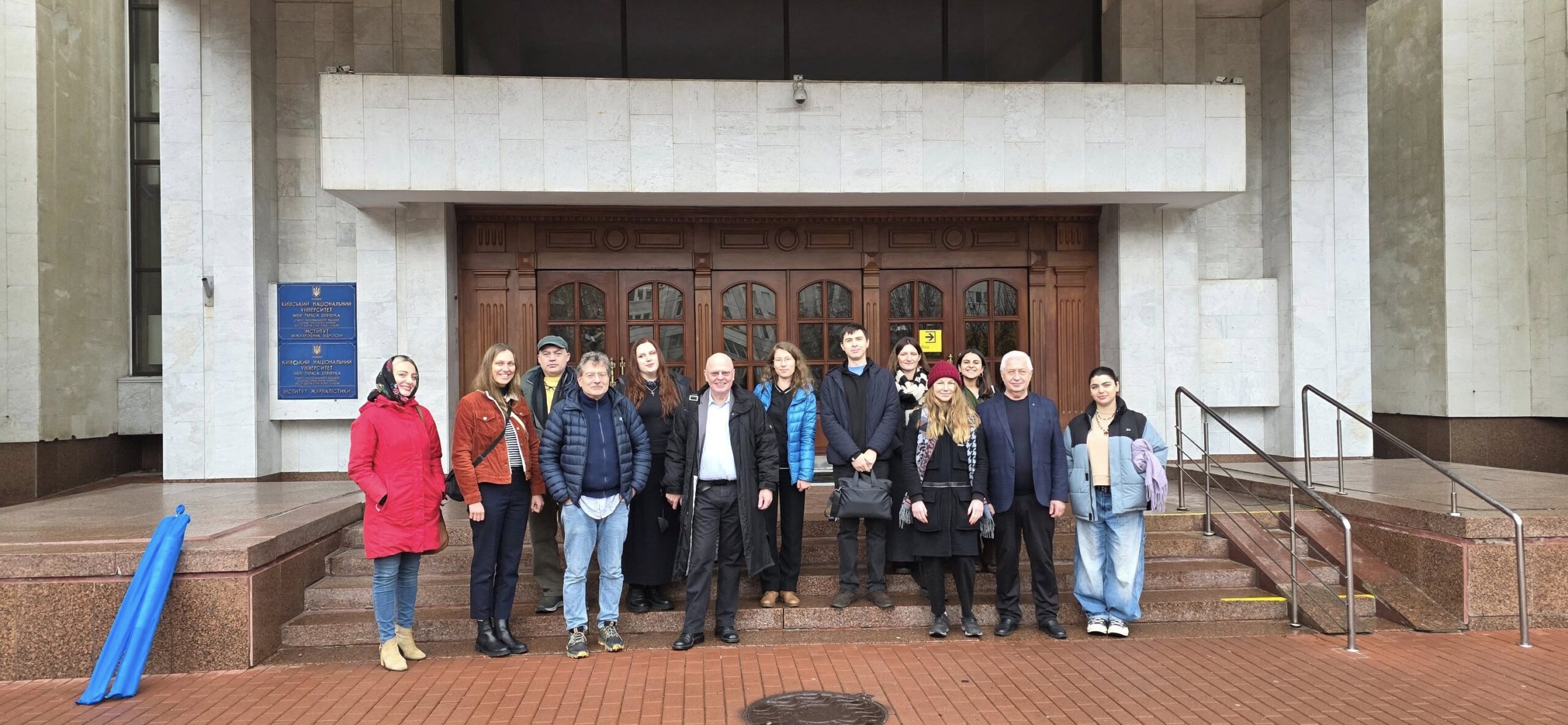
On 4 November, the participants of the Media Dialogue 2025 left Lutsk and continued their Ukrainian-Moldovan stage in Kyiv. They started the first day there by meeting the local members.
The opening ceremony took place at the Educational and Scientific Institute of Journalism, Taras Shevchenko National University of Kyiv, which is the official partner of Media Dialogue. As an organiser from the German side, Dr Wolfgang Ressmann explained that the project started in 2015, following the Maidan Nezalezhnosti events.
Не further elaborated that the main idea was to bring together lecturers, students, and journalists from post-Soviet countries who had experienced the aggression of the Russian government, and to organise a joint process focused on the issue of freedom of speech and democracy.
He emphasized the significance of the work: “We can protect the freedom of Ukraine and our freedom, too, in Europe”.
Now, the journalists from Ukraine, Georgia, Germany, Moldova, Armenia and Belarus who are in exile are taking part in the project.
Dr Ressmann noted that the Media Dialogue also opens a window for German media, allowing them to look behind the curtains on what’s really going on within the journalistic sphere in different countries.
“It’s the 10th anniversary of the Media Dialogue network. This is a sign of a person’s dedication to continue doing what they want to do. And it is not only just seeing each other and hugging, the work we are doing here is important. We have the results that we can show”, – said Mkrtich Tonoyan, organiser from the Armenia side.
He also noted that one of the arguments for their commitment is that two years ago there was no funding for this project, but the representatives took the initiative to visit Kyiv as a sign of their solidarity. The organiser encouraged participants to build links with each other and transformed it into long relationships. According to him, this is the best evolution of the interaction and such type of collaboration is one of the most productive against propaganda.
At the end of the meeting, students selected their trainers areas of responsibility for the next few days: blogs, storytelling and video materials.